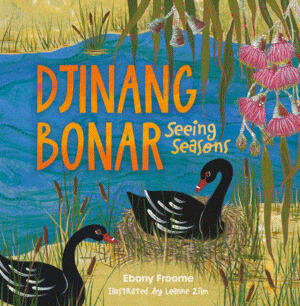
Djinang Bonar: Seeing Seasons
Djinang Bonar: Seeing Seasons
Ebony Froome
Leanne Zilm
Fremantle Press, 2024
32pp., hbk., RRP $A24.99
9781760994211
In some parts of Australia, the yellow of wattles and daffodils, fierce winds and can’t-make-up-their-mind temperatures are heralding Spring, one of four distinct seasons that our littlies learn about. In other parts, the heat and humidity are starting to build as the monotonous dry season ends and the Wet comes in with its tumultuous times: and in others First Nations peoples are seeing other signs as they move through their traditional cycles. For the Noongar in south-west region of Western Australia, this is the time of Djilba, the season of conception when the “koolbardi is swooping to protect his nest, when the dark emu is high in the kedalak sky, when the balgga stems emerge tall and strong, when the yonga and the koomool carry their babies.”
For generations, so many children have been taught that during this planet’s annual journey around the sun, we experience just four seasons – Spring, Summer, Autumn, Winter – but now perspectives are widening and beautiful books like this show that different peoples in different places have entirely different timeframes and different names for the patterns of Nature and its phenomena. For those on Noongar boodja there are six seasons, each with its own distinct signs and times…
- Birak—season of the young. First summer: December-January. …
- Bunuru—season of adolescence. Second summer: February-March. …
- Djeran—season of adulthood. Autumn: April-May. …
- Makuru—season of fertility. Winter: June-July. …
- Djilba—season of conception. First spring: August-September. …
- Kambarang—season of birth.
Written in a mix of English and Noongar but with indigenous words easily distinguishable by looking at the beautiful illustrations (with a glossary for clarification), the reader is taken on a journey through the calendar that, unlike the “English” version which has changes in weather at its heart. focuses on the subtle but significant changes that happen in the life of the local flora and fauna and form the patterns and cycles of life.
But even children on the East Coast, or those for whom Noongar is not their first language can appreciate the beauty and value of this book because it encourages them to look beyond those most obvious signs of change (many of which involve introduced species anyway) and examine the changes in the original, natural environment, and, indeed, their connections and interdependence. “On Noongar boodja, we know the season is Kambarang when… the kaaril [blue swimmer crab] is spawning and it’s best not take them.” It could also inspire an investigation into the indigenous weather knowledge of their own country as they not only learn to appreciate the knowledge that Aboriginal and Torres Strait Islander people have developed over thousands and thousands of years, but also better understand that connection to Country that is at the heart of their culture.
